.svg)

A phased transformation of airport infrastructure into a resilient, scalable, and human-centered mobility ecosystem.
Value Delivered
Project Overview
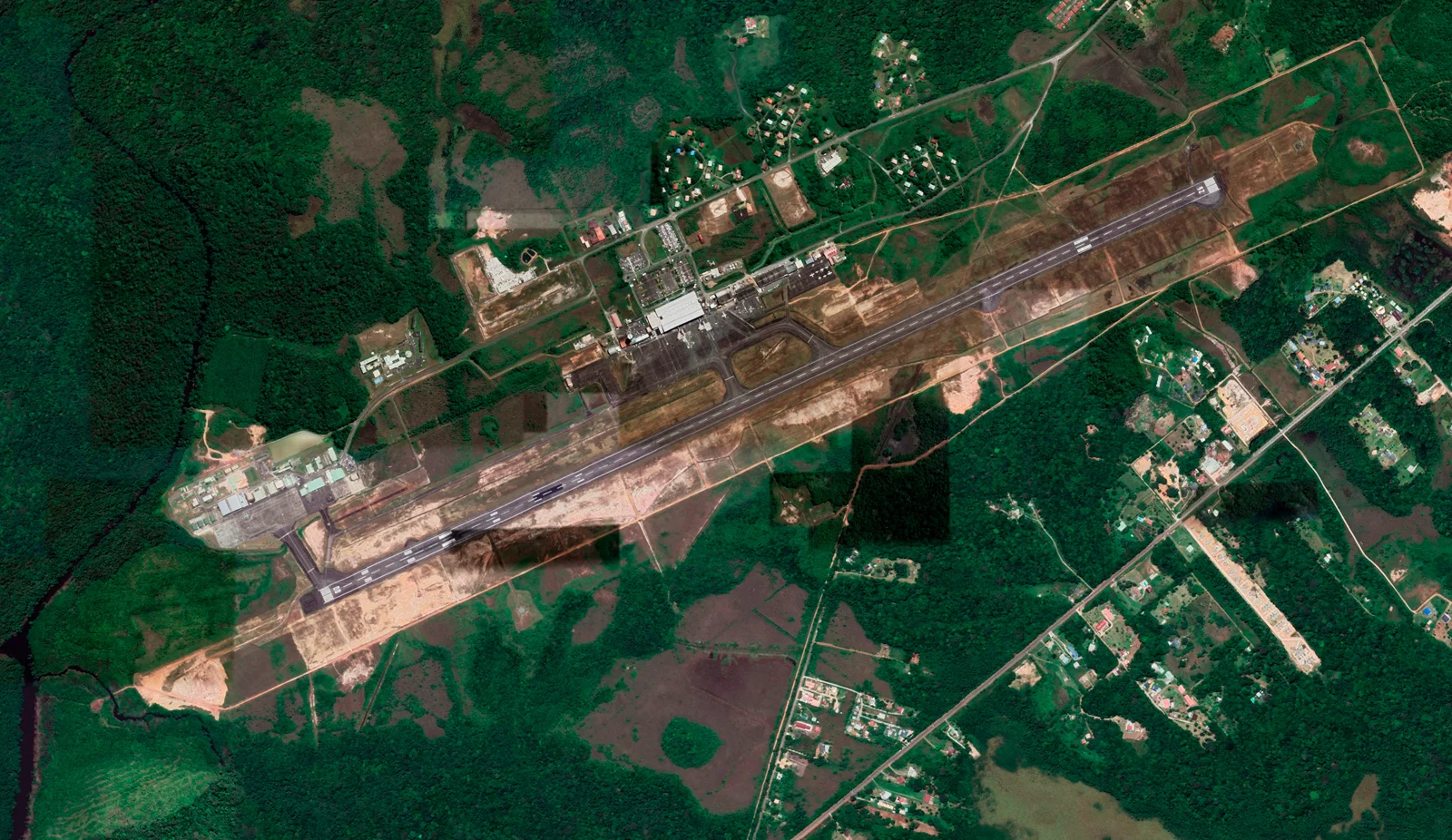
The Projet Ariane master plan defines a long-term vision for the expansion and optimization of Cayenne’s airport infrastructure, addressing growing passenger demand and evolving operational requirements. Developed as a phased strategy, the project integrates airside, landside, and support functions—ranging from aircraft parking and cargo facilities to maintenance, general aviation, and commercial development.
The proposal reflects a comprehensive approach to airport planning, aligning operational performance with spatial clarity and future adaptability. It considers both aviation-specific needs and broader territorial opportunities, including real estate development and passenger experience enhancement.
Key Challenge
The project must reconcile increasing traffic capacity with existing spatial, operational, and regulatory constraints. Current infrastructure reveals limitations in aircraft parking, general aviation capacity, cargo logistics, and service accessibility, alongside inefficiencies in circulation and compliance gaps in apron design.
Simultaneously, the coexistence of diverse functions—commercial aviation, general aviation, cargo, and sensitive operations linked to the Guiana Space Centre—requires precise spatial organization and secure yet fluid operational flows. The challenge lies in upgrading performance without disrupting ongoing airport activities or compromising safety and user experience.
Our Approach
The master plan is structured around a phased and modular strategy, enabling progressive capacity expansion while maintaining operational continuity.
On the airside, aircraft parking is reconfigured and expanded to accommodate increased traffic, including wide-body aircraft and simultaneous specialized operations. Functional zoning is clarified, separating commercial, general aviation, and technical areas to reduce conflicts and improve efficiency.
Support infrastructures are repositioned and optimized: maintenance hangars are relocated to eliminate operational overlaps, ground service equipment areas are expanded and reorganized, and cargo facilities are upgraded to support future growth, including improved logistics flows and specialized storage.
On the landside, the project enhances accessibility and passenger experience through expanded parking capacity, improved curbside organization, and better pedestrian protection adapted to local climatic conditions.
The plan also integrates a forward-looking development strategy, unlocking new zones for economic activities, hospitality, and environmental programs—transforming the airport into a multifunctional hub embedded within its regional context.
Throughout, the approach reflects 1PAX’s human-centered philosophy: simplifying flows, improving usability, and designing infrastructure that balances performance with comfort and clarity.