.svg)
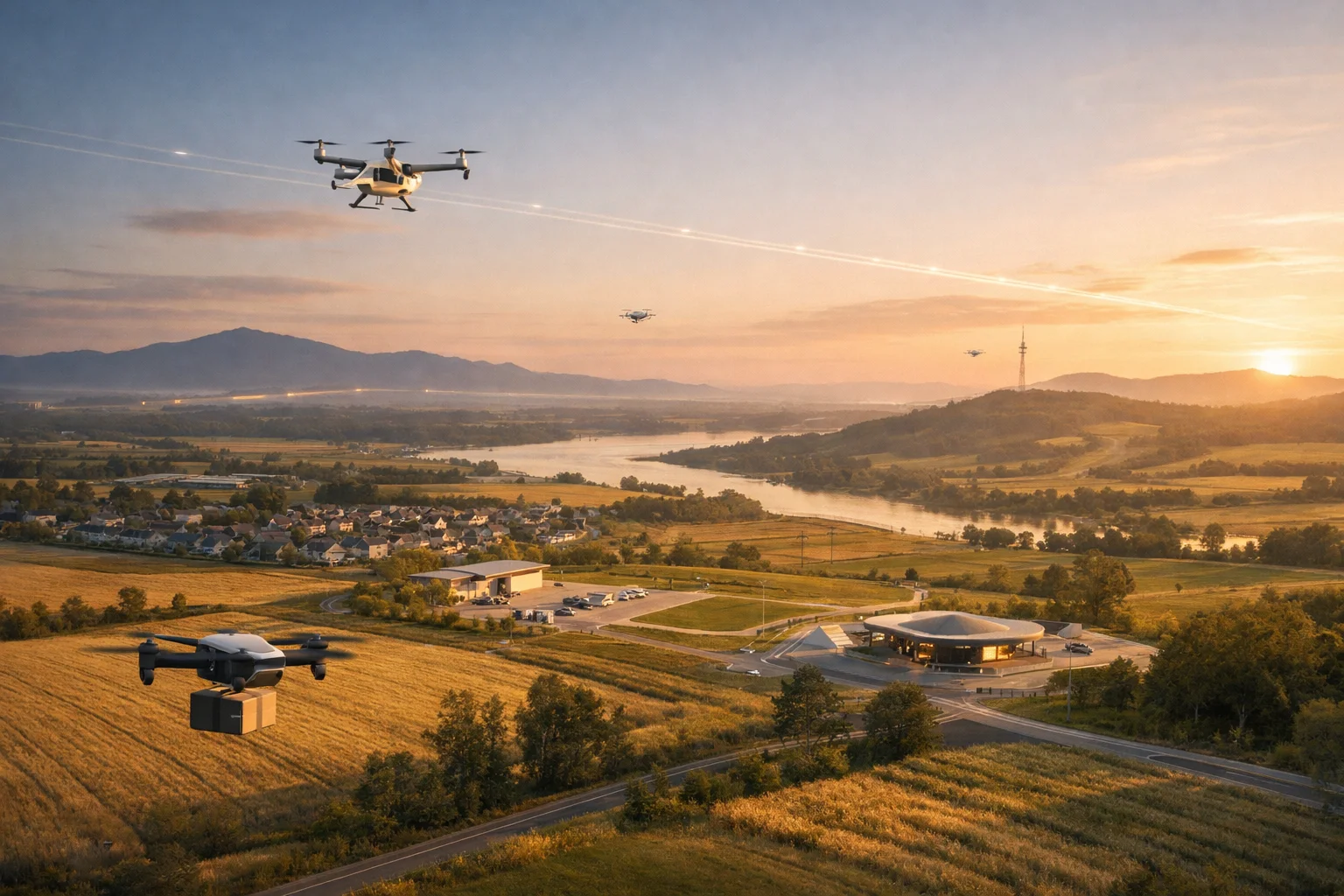
Connecting cities, peri-urban zones, and rural landscapes through a unified network of drones and eVTOL aircraft for medical logistics, emergency response, infrastructure inspection, and sustainable mobility.
1PAX has developed SKYLO, a strategic research and design framework focused on unlocking the potential of the low-altitude economy. Positioned at the intersection of architecture, mobility, and systems thinking, SKYLO explores how drones and eVTOLs can evolve from isolated pilots into scalable territorial infrastructure that delivers real public value.
Going beyond technology, the approach integrates regulation, spatial and environmental constraints, and social impact, with a strong focus on peri-urban and non-urban contexts.
The research combines vision, technical analysis, and international case studies—especially from Europe and China—into a clear investment narrative, offering decision-makers a practical methodology to deploy aerial logistics safely, progressively, and as a long-term driver of sustainability, resilience, and regional development.
The Problem: Ground Logistics Is Reaching Its Limits
Urban congestion, fragmented infrastructure, and remote territories slow down critical operations. Examples include:
- Medical organs trapped in traffic
- Flood response delayed by blocked roads
- Infrastructure inspections requiring risky manual work
- Remote communities cut off from essential services
The current system relies almost entirely on ground transport, even when the fastest route is through the air.
The SKYLO Solution: A Connected Aerial Logistics Network
SKYLO proposes a multi-scale aerial logistics system using drones and eVTOL aircraft.
The network connects three operational environments:
- Urban zones
- High demand, dense infrastructure, rapid medical and security services.
- Peri-urban zones
- Ideal locations for logistics hubs, charging stations, and emergency coordination.
- Rural landscapes
- Open airspace enabling long-range operations for agriculture, disaster response, and tourism.
This system transforms airspace into a distributed logistics layer above traditional transport networks.
Core Applications
SKYLO integrates 10 operational scenarios across different territories, including:
- Medical Logistics
- Organ transport
- Blood and medicine delivery
- Emergency medical supplies
Example impact:
- Heart transplant delivery reduced from 30–55 minutes to 7–10 minutes.
- Infrastructure Monitoring
- High-rise building inspection
- Power line monitoring
- Tunnel and underground infrastructure scanning
Benefits:
- Up to 80% faster inspections
- Reduced worker risk
- Disaster Response
- Flood mapping
- Wildfire hotspot detection
- Search and rescue missions
Drones provide:
- Real-time aerial mapping
- Rapid supply delivery
- Improved emergency coordination.
- Environmental & Agricultural Operations
- Crop monitoring
- Precision seeding
- Wildlife and tourism management
Drone monitoring can survey 100% of an area in minutes, compared with hours of manual work.
Performance Indicators
The SKYLO toolkit evaluates aerial logistics through measurable metrics:
- Coverage
- Percentage of territory or infrastructure monitored.
- Response Speed
- Mission time compared with traditional ground operations.
- Efficiency
- Operational performance and resource optimization.
- Cost Efficiency
- Reduction in logistics cost and operational complexity.
- Safety
- Reduction of human exposure to dangerous environments.
Global Expansion Potential
While the initial concept focuses on France, SKYLO also proposes global corridors for extreme geographies, including:
- Amazon Basin
- Remote river communities where travel can take days.
- Drone/eVTOL operations could reduce journeys from 2–4 days to about 1 hour.
- Patagonian Fjords
- Mountain and maritime landscapes where roads and ferries limit mobility.
Low-carbon aerial transport can connect isolated communities in a fraction of the time.
Strategic Impact
SKYLO demonstrates how aerial logistics can become a core infrastructure layer for future mobility.
Potential impacts include:
- Faster medical response
- Safer infrastructure maintenance
- Climate-efficient logistics
- Improved connectivity for remote regions
- New economic opportunities in rural territories
Build the Next Layer of Mobility
SKYLO invites collaboration with cities and regional governments, healthcare institutions, mobility innovators, logistics operators and research institutions. Together, we can transform airspace into a sustainable logistics network for the 21st century.